Case study
One dashboard for a client fleet — without agents
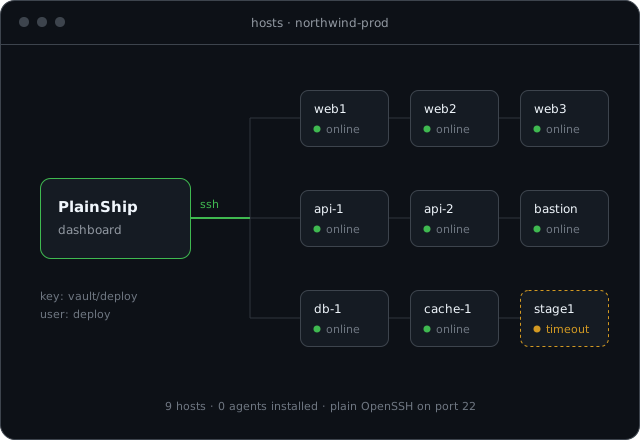
An agency consolidated client VPS work into hosted PlainShip: shared vault, readable deploys and SSH access that does not live on personal laptops.
Context
Agencies often inherit a patchwork of client servers — Hetzner, DigitalOcean, a leftover Linode — each with its own deploy ritual. The team needed a single place to ship releases, open shells and hand off access when people rotate on and off a retainer.
Previously, each senior engineer kept a private inventory of hosts and keys. Junior staff waited for a shared screen session to deploy. Clients asked for auditability the agency could not show without digging through chat history.
Installing agents on client boxes was a non-starter: many contracts forbid third-party daemons, and security reviews already push back on anything beyond SSH.
Before
When a retainer engineer left, recovering access meant asking the client for a new key and hoping the old one was revoked. Night-time incidents required the one person who remembered the host nickname.
- Deploy keys and passwords stored in personal password managers
- Release steps documented in Notion pages that went stale
- No shared view of who deployed what to which client host
- Onboarding meant copying SSH configs between machines
Why PlainShip
Coolify-style platforms assumed containers the clients did not run. Ansible control nodes were heavier than the agency wanted to maintain. Hosted PlainShip matched the work they already did — SSH, bash, releases — with a UI clients could understand in a short walkthrough.
- Agentless SSH fits contracts that ban extra software on the host
- Workspace roles let juniors deploy without owning the vault
- Atomic releases give clients a clear rollback story
- Browser terminal reduces jumping between local SSH profiles
Setup on app.plainship.dev
- 01
Created one PlainShip project per major client, with host groups for staging and production
- 02
Imported deploy keys into the vault and removed copies from personal machines
- 03
Standardized atomic releases for PHP and Node apps with a healthcheck URL
- 04
Gave client tech leads read access to activity history for audits
Playbooks covered the boring weekly work: renewals checks, log rotation and package updates. Dry runs on staging first became the habit before touching production groups.
Schedules on Pro replaced a tangle of per-host crontabs for health pings. Failures land in email so the on-call person does not need to remember every box.
After
- 12+Client hosts in one dashboard
- 0Agents installed on client servers
- MinutesTo grant a new teammate deploy access
Hand-offs got shorter. A new engineer joins the workspace, sees the hosts and the last release, and opens a shell without collecting keys from three people. Clients see a consistent process instead of heroics.
What we learned
- Agentless is often a procurement requirement, not just a preference.
- A shared vault is the real unlock for agency staffing changes.
- Clients trust deploys they can see in a history list.
- Keep playbooks boring and readable — agencies ship under pressure.
“We stopped shipping from whoever happened to have the laptop with the right key. The client fleet lives in one place now.”